Kamis, 10 Februari 2011

North American P-51 Mustang Papermodel Download

The North American Aviation P-51 Mustang was an American long-range single-seat World War II fighter aircraft. Designed and built in just 117 days to a specification issued to NAA by the British Purchasing Commission, the Mustang first flew in Royal Air Force (RAF) service as a fighter-bomber and reconnaissance aircraft before conversion to a bomber escort, employed in raids over Germany, helping ensure Allied air superiority from early 1944.[2] The P-51 was in service with Allied air forces in Europe and also saw limited service against the Japanese in the Pacific War. At the start of Korean War the Mustang was the United Nations' main fighter but the role was quickly shouldered by jet fighters, including the F-86, after which the Mustang became a specialised ground-attack fighter-bomber. In spite of being superseded by jet fighters the Mustang remained in service with some air forces until the early 1980s.
As well as being economical to produce, the Mustang was a fast, well-made, and highly durable aircraft. The definitive version, the P-51D, was powered by the Packard V-1650, a two-stage two-speed supercharged version of the legendary Rolls-Royce Merlin engine, and was armed with six .50 caliber (12.7 mm) M2 Browning machine guns.
After World War II and the Korean War, many Mustangs were converted for civilian use, especially air racing. The Mustang's reputation was such that, in the mid-1960s, Ford Motor Company's Designer John Najjar proposed a new youth-oriented coupe automobile be named after the fighter.
General characteristics
Performance
http://en.wikipedia.org/wiki/P-51
 North American P-51 Mustang Papermodel Download >>>> Download

Messerschmitt Bf 109 Papermodel Download

The Messerschmitt Bf 109 (often called Me 109) was a German World War II fighter aircraft designed by Willy Messerschmitt and Robert Lusser during the early to mid 1930s.It was one of the first true modern fighters of the era, including such features as an all-metal monocoque construction, a closed canopy, a retractable landing gear, and was powered by liquid-cooled, inverted-V12 aero engines. The 109 first saw operational service during the Spanish Civil War and was still in service at the dawn of the jet age at the end of World War II, during which time it was the backbone of the Luftwaffe's fighter force.[From the end of 1941 the Bf 109 was supplemented by the Focke-Wulf Fw 190.
Originally conceived as an interceptor, later models were developed to fulfill multiple tasks, serving as bomber escort, fighter bomber, day-, night- all-weather fighter, bomber destroyer, ground-attack aircraft, and as reconnaissance aircraft. It was supplied to and operated by several states during World War II, and served with several countries for many years after the war. The Bf 109 was the most produced warplane during World War II, with 30,573 examples built during the war, and the most produced fighter aircraft in history, with a total of 33,984 units produced up to April 1945
The Bf 109 was flown by the three top-scoring German fighter aces of World War II, who claimed 928 victories among them while flying with Jagdgeschwader 52, chiefly on the Eastern Front, as well as by the highest scoring German ace in the North African Campaign. It was also flown by several other successful aces from Germany's allies, notably Finland, including the highest scoring non-German ace Ilmari Juutilainen, and pilots from Romania, Croatia and Hungary. Through constant development, the Bf 109 remained competitive with the latest Allied fighter aircraft until the end of the war.
General characteristics
  • Crew: One
  • Length: 8.95 m (29 ft 7 in)
  • Wingspan: 9.925 m (32 ft 6 in)
  • Height: 2.60 m (8 ft 2 in)
  • Wing area: 16.05 m² (173.3 ft²)
  • Empty weight: 2,247 kg (5,893 lb)
  • Loaded weight: 3148 kg (6,940 lb)
  • Max takeoff weight: 3,400 kg (7,495 lb)
  • Powerplant: 1× Daimler-Benz DB 605A-1 liquid-cooled inverted V12, 1,475 PS (1,455 hp, 1,085 kW)
  • Propellers: VDM 9-12087 three-bladed light-alloy propeller
    • Propeller diameter: 3 m (9.84 ft) ()
Performance
 Messerschmitt Bf 109 Papermodel Download >>>>> Download
Download

Selasa, 08 Februari 2011

Junkers Ju-88 Papermodel download

The Junkers Ju 88 was a World War II German Luftwaffe twin-engine, multi-role aircraft. Designed by Hugo Junkers' company in the mid-1930s, it suffered from a number of technical problems during the later stages of its development and early operational roles, but became one of the most versatile combat aircraft of the war. Affectionately known as "The Maid of all Work" (a feminine version of "jack of all trades"), the Ju 88 proved to be suited to almost any role. Like a number of other Luftwaffe bombers, it was used successfully as a bomber, dive bomber, night fighter, torpedo bomber, reconnaissance aircraft, heavy fighter, and even as a flying bomb during the closing stages of conflict.
Despite its protracted development, the aircraft became one of the Luftwaffe's most important assets. The assembly line ran constantly from 1936 to 1945, and more than 16,000 Ju 88s were built in dozens of variants, more than any other twin-engine German aircraft of the period. Throughout the production, the basic structure of the aircraft remained unchanged, proof of the outstanding quality of the original design.
General characteristics
  • Crew: 4
  • Length: 14.36 m (47 ft 2⅞ in)
  • Wingspan: 20.08 m (65.88 ft)
  • Height: 5.07 m (16.63 ft)
  • Wing area: 54.7 m² (587 ft²)
  • Loaded weight: 8,550 kg (18,832 lb)
  • Max takeoff weight: 14,000 kg[50] (30,865 lb)
  • Powerplant: 2× Junkers Jumo 211J [51] liquid-cooled inverted V-12, 1,044 kW (1,420 PS, 1,401 hp) each
Performance
  • Maximum speed: 510 km/h[50] (317 mph) at 5,300 m (17,388 ft) without external bomb racks
  • Range: 2,430 km[50] (1,429 mi) maximum internal fuel
  • Service ceiling: 9,000 m (29,500 ft) at average weight, without bombs
 http://en.wikipedia.org/wiki/Junkers_Ju_88
 Junkers Ju-88 Papermodel download >>>> Download

P-40 Skyhawk Papermodel Download

The Curtiss P-40 Warhawk was an American single-engine, single-seat, all-metal fighter and ground attack aircraft that first flew in 1938. It was used by the air forces of 28 nations, including those of most Allied powers during World War II, and remained in front line service until the end of the war. It was the third most produced American fighter ever, after the P-51 and P-47; by November 1944, when production of the P-40 ceased, 13,738 had been built,[3] all at Curtiss-Wright Corporation's main production facility at Buffalo, New York.
The P-40 design was a modification of the previous Curtiss P-36; this reduced development time and enabled a rapid entry into production and operational service.
Warhawk was the name the United States Army Air Corps adopted for all models, making it the official name in the United States for all P-40s. The British Commonwealth and Soviet air forces used the name Tomahawk for models equivalent to the P-40B and P-40C, and the name Kittyhawk for models equivalent to the P-40D and all later variants.
General characteristics
  • Crew: 1
  • Length: 31.67 ft (9.66 m)
  • Wingspan: 37.33 ft (11.38 m)
  • Height: 12.33 ft (3.76 m)
  • Wing area: 235.94 ft² (21.92 m²)
  • Empty weight: 6,350 lb (2,880 kg)
  • Loaded weight: 8,280 lb (3,760 kg)
  • Max takeoff weight: 8,810 lb (4,000 kg)
  • Powerplant: 1× Allison V-1710-39 liquid-cooled V12 engine, 1,150 hp (858 kW)
Performance
 http://en.wikipedia.org/wiki/Curtiss_P-40_Warhawk

 P-40 Skyhawk Papermodel Download >>>>>> Download

Messerschmitt Bf 110 Papermodel Download

The Messerschmitt Bf 110, often (erroneously) called Me 110, was a twin-engine heavy fighter (Zerstörer - German for "Destroyer") in the service of the Luftwaffe during World War II. Hermann Göring was a proponent of the Bf 110, and nicknamed it his Eisenseiten ("Ironsides"). Development work on an improved type to replace the Bf 110, the Messerschmitt Me 210 began before the war started, but its teething troubles resulted in the Bf 110 soldiering on until the end of the war in various roles, alongside its replacements, the Me 210 and the Me 410.
The Bf 110 served with success in the early campaigns, the Polish, Norwegian and Battle of France. The Bf 110's lack of agility in the air was its primary weakness. This flaw was exposed during the Battle of Britain, when some Bf 110-equipped units were withdrawn from the battle after very heavy losses and redeployed as night fighters, a role to which the aircraft was well suited. The Bf 110 enjoyed a successful period following the Battle of Britain as an air superiority fighter and strike aircraft in other theatres. During the Balkans Campaign, North African Campaign and on the Eastern Front, it rendered valuable ground support to the German Army as a potent fighter-bomber (Jagdbomber-Jabo). Later in the war, it was developed into a formidable night fighter, becoming the major night-fighting aircraft of the Luftwaffe. Most of the German night fighter aces flew the Bf 110 at some point during their combat careers, and the top night fighter ace of all time, Major Heinz-Wolfgang Schnaufer, flew it exclusively and claimed 121 victories in 164 combat missions.
General characteristics
  • Crew: 2 (3 for night fighter variants)
  • Length: 12.3 m (40 ft 6 in)
  • Wingspan: 16.3 m (53 ft 4 in)
  • Height: 3.3 m (10 ft 9 in)
  • Wing area: 38.8 m² (414 ft²)
  • Empty weight: 4,500 kg (9,921 lb)
  • Loaded weight: 6,700 kg (14,771 lb)
  • Powerplant: 2× Daimler-Benz DB 601B-1 liquid-cooled inverted V-12, 809 kW (1,085 hp)1,100 PS each
Performance
 Messerschmitt Bf 110 Papermodel Download >>>>

Download

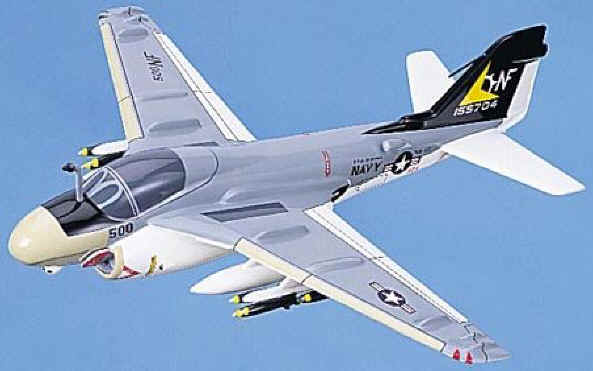
A-6 Intruder Papermodel Download

The Grumman A-6 Intruder was a twin jet-engine, mid-wing attack aircraft built in the United States by Grumman Aerospace. In service with the U.S. Navy and U.S. Marine Corps between 1963 and 1997, the Intruder was designed as an all-weather medium attack aircraft to replace the piston-engined A-1 Skyraider. As the A-6E was slated for retirement, its precision strike mission was taken over by the F-14 Tomcat equipped with LANTIRN pod. A specialized electronic warfare derivative, the EA-6B Prowler, remains in service as of 2011.
The definitive attack version of the Intruder, introduced in 1970, with its first deployment, 9 December 1971, with vastly upgraded navigation and attack systems. The earlier separate search and track (fire control) radars of the A-6A/B/C were replaced by a single Norden AN/APQ-148 multi-mode radar, and the onboard computers with a more sophisticated (and generally more reliable) IC based system, as opposed to the A-6A's DIANE discrete transistor-based technology. A new AN/ASN-92 inertial navigation system was added, along with the CAINS (Carrier Aircraft Intertial Navigation System), for greater navigation accuracy.
Beginning in 1979, all A-6Es were fitted with the AN/AAS-33 DRS (Detecting and Ranging Set), part of the "Target Recognition and Attack Multi-Sensor" (TRAM) system, a small, gyroscopically stabilized turret, mounted under the nose of the aircraft, containing a FLIR boresighted with a laser spot-tracker/designator and IBM System/4 Pi computer. TRAM was matched with a new Norden AN/APQ-156 radar. The BN could use both TRAM imagery and radar data for extremely accurate attacks, or use the TRAM sensors alone to attack without using the Intruder's radar (which might warn the target). TRAM also allowed the Intruder to autonomously designate and drop laser-guided bombs. In addition, the Intruder used AMTI (Airborne Moving Target Indicator) which allowed the aircraft to track a moving target (such as a tank or truck) and drop ordnance on him even though the target was moving. Also, the computer system allowed the use of Offset Aim Point (OAP), giving the crew the ability to drop on a target unseen on radar by noting coordinates of a known target nearby and entering the offset range and bearing to the unseen target.
In the early 1990s some surviving A-6Es were upgraded under SWIP (Systems/Weapons Improvement Program) to enable them to use the latest precision-guided munitions, including AGM-65 Mavericks, AGM-84 Harpoons, AGM-84E SLAMs, AGM-62 Walleyes and the AGM-88 HARM anti-radiation missile. After a series of wing-fatigue problems, about 85% of the fleet was fitted with new graphite/epoxy/titanium/aluminum composite wings.
A-6E models totaled 445 aircraft, about 240 of which were converted from earlier A-6A/B/C models.

General characteristics
http://en.wikipedia.org/wiki/Grumman_A-6_Intruder

Download A-6 Intruder Paper Model >>> Download

Mitsubishi A6M Zero Papermodel Download

The Mitsubishi A6M Zero was a long range fighter aircraft operated by the Imperial Japanese Navy Air Service (IJNAS) from 1940 to 1945. The A6M was designated as the Mitsubishi Navy Type 0 Carrier Fighter (零式艦上戦闘機 rei-shiki-kanjou-sentouki?), and also designated as the Mitsubishi A6M Rei-sen and Mitsubishi Navy 12-shi Carrier Fighter. The A6M was usually referred to by the Allies as the "Zero", from the 'Navy Type 0 Carrier Fighter' designation. The official Allied reporting name was Zeke.
When it was introduced early in World War II, the Zero was the best carrier-based fighter in the world, combining excellent maneuverability and very long range. In early combat operations, the Zero gained a legendary reputation as a "dogfighter", achieving the outstanding kill ratio of 12 to 1, but by 1942 a combination of new tactics and the introduction of better equipment enabled the Allied pilots to engage the Zero on more equal terms. The Imperial Japanese Naval Air Service (IJNAS) also frequently used the type as a land-based fighter. By 1943, inherent design weaknesses and the increasing lack of more powerful aircraft engines meant that the Zero became less effective against newer enemy fighters that possessed greater firepower, armor, and speed, and approached the Zero's maneuverability. Although the Mitsubishi A6M was outdated by 1944, it was never totally supplanted by the newer Japanese aircraft types. During the final years of the War in the Pacific, the Zero was used in kamikaze operations. In the course of the war, more Zeros were built than any other Japanese aircraft.
 
General characteristics
Performance
 Mitsubishi A6M Zero Papermodel Download >>>>> Download